The Real Cost of One Leasing File: Why Paper Is Costing Sri Lankan Finance Companies LKR 19 Million a Year
One leasing file costs about LKR 4,000 in printing, courier, staff time and storage. See how paper adds up to LKR 19.2 million a year for a mid-sized finance company, and how e-signatures cut it.
On this page (5)
Ask a finance company how long a vehicle lease takes and you'll usually hear about credit approval. But approval is often the fast part. The slow, expensive part comes after, when the paperwork starts moving.
Let's follow one leasing file from approval to signed agreement.
The paper journey
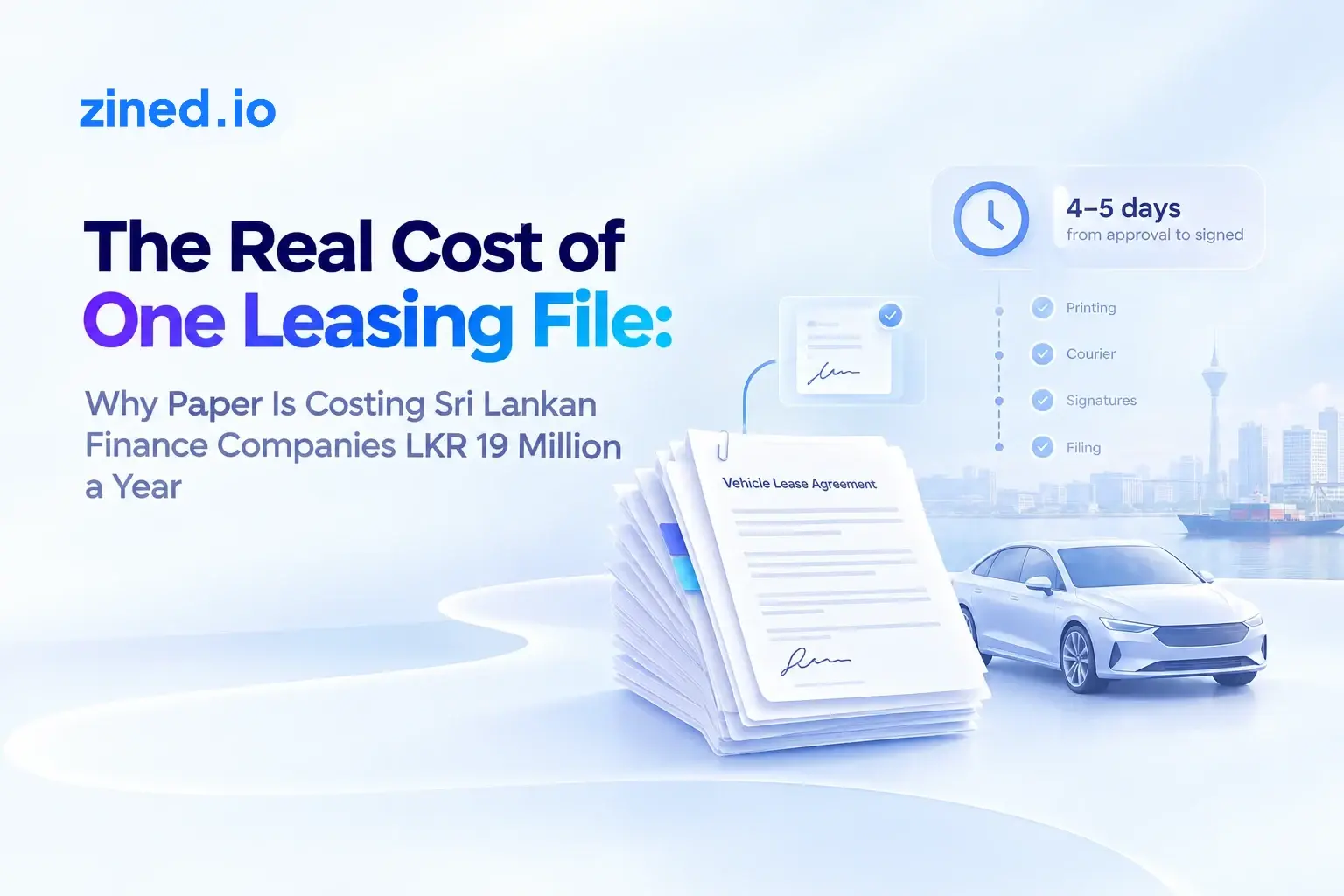
Day 1: Approval. Credit approves the lease. The agreement is printed, usually several copies with annexures.
Day 1–2: Customer signing. The customer comes to the branch, or an officer visits them. If a page is missed or something needs correcting, it's reprinted and they come back.
Day 2–4: Guarantor signing. The guarantor lives in another city. The documents go by courier, wait for the guarantor to be available, and come back by courier.
Day 4–5: Internal sign-offs. The file moves between the branch and head office for final checks and signatures.
Day 5+: Filing. The signed originals are scanned, filed, and stored, and have to be retrieved every time an audit asks.
That's 4–5 days from "approved" to "done" for a deal that was agreed on Day 1.
Adding up the cost
Here's what one leasing file costs. The figures below are conservative estimates for a mid-sized finance company. Your own numbers may vary.
| Cost item | Assumption | Per file |
|---|---|---|
| Printing | Agreement + annexures, ~40 pages × 3 copies @ LKR 10/page | LKR 1,200 |
| Courier | Guarantor round trip, document rate both ways | LKR 800 |
| Staff time | 3.5 hours of branch officer time (printing, chasing, checking, filing) @ ~LKR 500/hour loaded cost | LKR 1,750 |
| Physical storage and retrieval | Annual storage, filing, and audit retrieval, per file | LKR 250 |
| Total | LKR 4,000 |
Now scale it. A finance company doing 400 leasing files a month across 12 branches signs 4,800 files a year:
4,800 files × LKR 4,000 = LKR 19.2 million a year.
On paperwork. Not on credit risk, not on acquisition, not on collections. On printing, couriering, chasing, and storing documents that were already approved.
And that's before the reprints. Industry experience suggests a meaningful share of files need at least one page reprinted or re-signed, which adds another round of courier and another day of delay.
The costs that don't show up on a spreadsheet
- Lost deals. Every day between approval and signature is a day the customer can change their mind or go to a competitor who's faster.
- Customer frustration. Extra branch visits and "please come back to sign page 7" hurt your brand.
- Errors and missing pages. Incomplete files cause rework and audit findings.
- Staff burnout. Your branch teams should be selling and serving customers, not chasing paperwork.
The same file, signed digitally
- Approval: the agreement is generated and sent for signing within minutes.
- Customer: signs on their phone with OTP verification. No branch visit.
- Guarantor: signs from anywhere, at the same time. No courier.
- Internal sign-offs: routed automatically in the right order.
- Filing: the signed document and full audit trail are stored and searchable instantly.
From 4–5 days to a few hours, with no printing, no courier, and no chasing. If you're wondering whether this holds up legally, we cover that in Are e-signatures legal for leasing and loan agreements in Sri Lanka?
Where to start
Pick your highest-volume, most paper-heavy process. For most finance companies that's leasing or fixed deposit renewals. Measure what it costs today, then run a pilot and compare. The numbers usually make the case on their own. Our banking and financial services page shows how this looks in practice, and reusable templates make repeat agreements like leases quick to send.
See what your branches could save. Book a demo.
Put the ideas into practice
Build a faster signature workflow with Zined
Use automated sends, reusable templates, AI-assisted reviews, and enterprise-ready controls to move agreements forward without adding friction for signers.
Keep reading
Related articles

eSignatures for Sri Lanka BPOs: How to Send Contracts to International Clients the Right Way
Sri Lanka's BPO sector serves clients in the EU, US, and Australia who expect GDPR-compliant digital workflows. Here is how to build a signing process that meets international standards, handles high document volumes, and answers the data compliance questions your clients are already asking.

eSignatures for HR in Sri Lanka: What You Can Digitise and What Still Needs Wet Ink
Most HR content about digital signing says go fully paperless. In Sri Lanka, that is not entirely true. This guide covers exactly what HR teams can digitise today, what the Labour Department still requires in hardcopy, and how to build a compliant hybrid workflow.
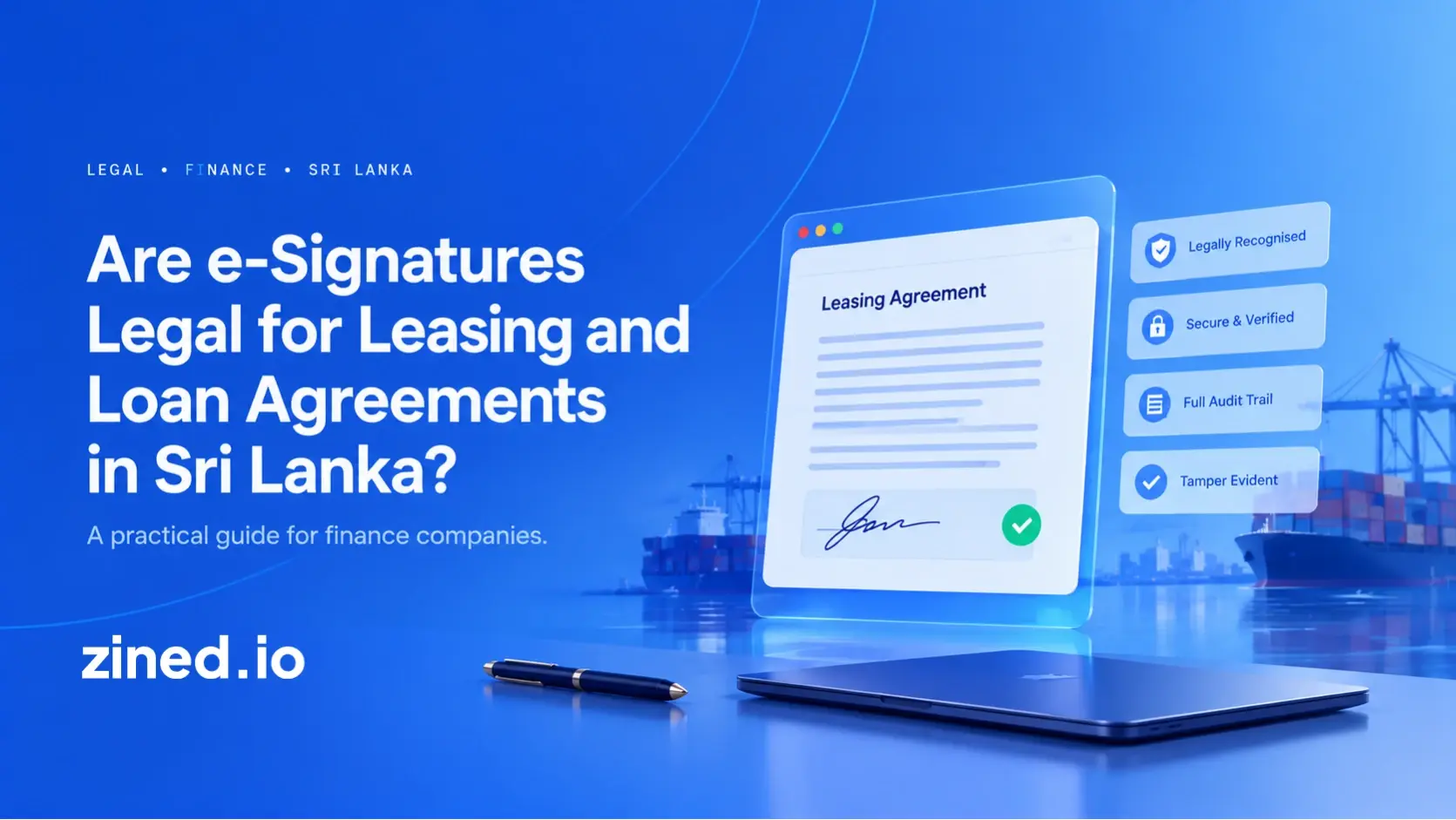
Are E-Signatures Legal for Leasing and Loan Agreements in Sri Lanka?
Sri Lanka's Electronic Transactions Act recognises e-signatures. A practical guide for finance companies on which leasing and loan documents can be signed digitally today, what is excluded, and how to roll out safely.