What Is Contract Lifecycle Management (CLM)?
Contract lifecycle management explained: the stages, what CLM software does, market data, KPIs to track and how to tell if your team needs it.
On this page (9)
Contract lifecycle management (CLM) is how an organisation runs a contract from first request to renewal or expiry. It covers the process, the people and usually the software that holds it together.
Why contract management matters, in numbers
The main cost is value lost after signature, when nobody tracks what was agreed.
| Measure | Figure | Source |
|---|---|---|
| Average contract value erosion | 8.6% | Deloitte |
| Best performers' erosion | Just over 3% | Deloitte |
| Worst performers' erosion | Above 20% | Deloitte |
| Systems holding contract data in large organisations | 24 on average | Deloitte |
| Cost to process and review a standard contract | $6,900 on average (2018) | IACCM, now WorldCC |
On $10 million of contracts, 8.6% erosion equals $860,000. Reaching the best performers' 3% would keep about $560,000 of that.
The stages of the contract lifecycle
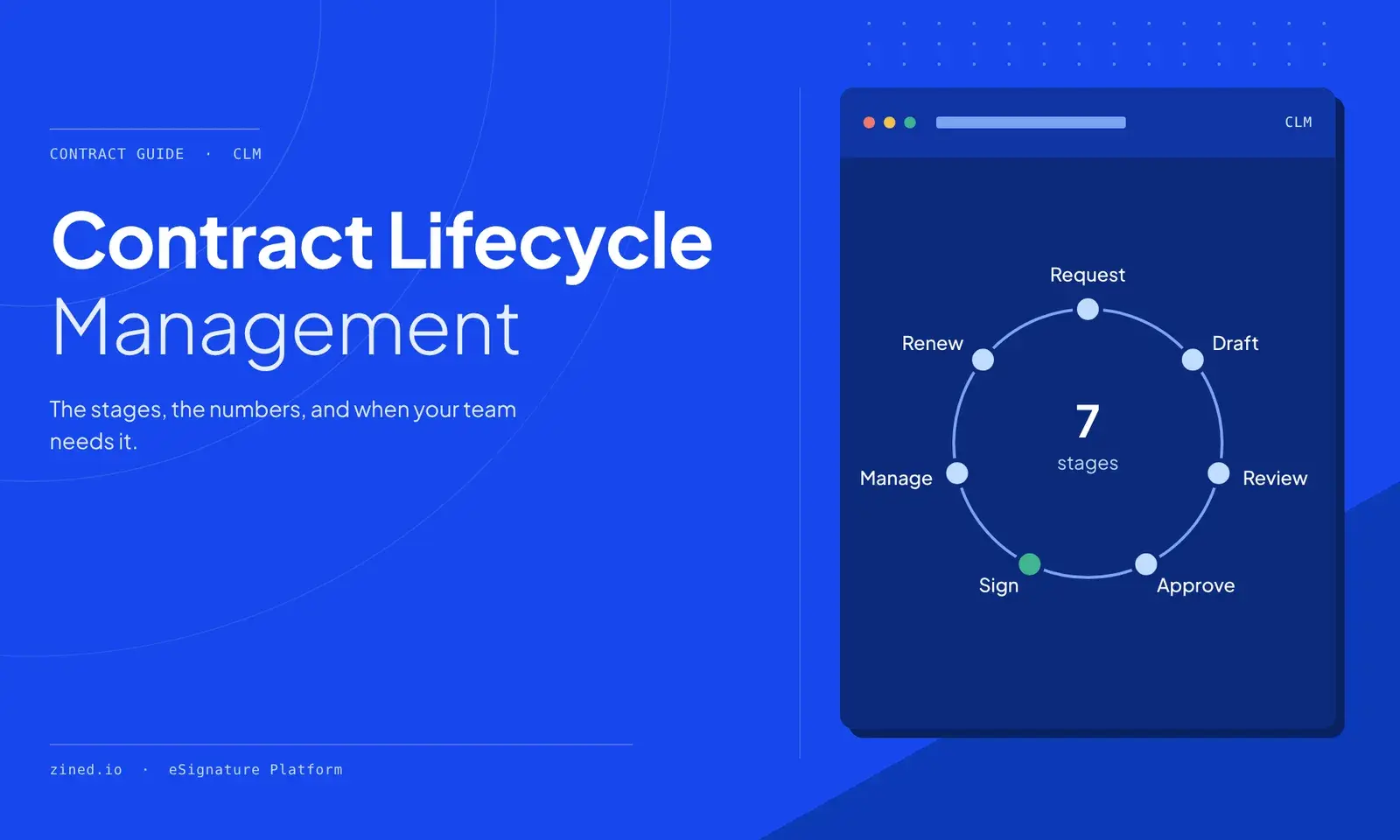
Vendors label these stages differently, but most models follow the same seven steps in order.
- Request. A team asks for a contract and gives the commercial details.
- Draft. Legal or the business team builds it, ideally from an approved template.
- Review and negotiate. The parties mark up terms and agree changes.
- Approve. Internal owners such as legal, finance and leadership sign off.
- Sign. The parties execute the contract, on paper or with a legally binding electronic signature.
- Manage obligations. Someone tracks deliverables, payments, service levels and deadlines.
- Renew or close. The team renews, renegotiates or ends the contract, then archives it.
Stages 1 to 5 get most of the attention because they delay deals. Stage 6 is where value usually leaks, because the signed contract goes into a folder and no one owns the follow-through.
What CLM software does
CLM software puts those stages in one system with a single contract record. Typical features are a contract repository, templates, approval workflows, e-signature, deadline alerts and reporting.
The market is growing but still fairly small. GM Insights puts CLM software above $1.24 billion, heading to $3.7 billion by 2034 at about 13% a year. It reports cloud at over 63% of deployments in 2025. Its top seven vendors hold just over 30% combined, so buyers have plenty of choice.
When your team needs CLM software
Full CLM makes sense once contract volume and risk outgrow shared folders.
| Your situation | What usually fits |
|---|---|
| A few contracts a month, one owner | Templates, shared folders, an e-signature tool |
| Dozens a month, several teams, missed renewals | E-signature plus a repository, reminders and workflows |
| Hundreds a month, regulated work, heavy negotiation | A full CLM platform with integrations and analytics |
These bands are a rule of thumb, not an industry standard. A team with a few very high-value contracts may need more control than its volume suggests.
KPIs to track
Measure a baseline before you change tools, or you will not be able to show any improvement.
| KPI | What it tells you |
|---|---|
| Cycle time from request to signature | How long contracts hold up the business |
| Time spent in each stage | Where the bottleneck is |
| Renewals missed or auto-renewed by accident | Whether deadlines are under control |
| Obligations completed on time | Whether agreed value is being delivered |
| Share of contracts on standard templates | How much review work you can remove |
Common mistakes
- Buying software before fixing the process. Software speeds up the process you already have, including its problems.
- Skipping simplification. Deloitte found over 50% of organisations had neither carried out nor planned contract simplification.
- Stopping at signature. Without an owner for each obligation, stage 6 is where value disappears.
- Migrating nothing. Old contracts left outside the system leave renewal dates and risk hidden.
- No single owner. When legal, sales and procurement each hold part of the process, gaps appear between them.
FAQ
What does CLM stand for? Contract lifecycle management.
What is the difference between CLM and e-signature? E-signature covers one stage, execution. CLM covers the whole contract, from request through renewal.
Is contract management the same as CLM? They overlap. Contract management often refers to work after signature, while CLM normally spans every stage.
Who owns CLM? It varies. Legal, procurement, sales operations and finance can all lead, but one named owner works better than shared ownership.
Where to start
Pick one contract type, map its stages and time each one. That small exercise shows whether you have a tooling problem or a process problem.
If the slowest parts are drafting, sending and signing, a lighter tool may be enough. Zined combines document management, a contract editor and e-signatures for teams at that stage, including legal and professional services firms that live in this workflow daily. See plans and pricing for the details.
Sources
Put the ideas into practice
Build a faster signature workflow with Zined
Use automated sends, reusable templates, AI-assisted reviews, and enterprise-ready controls to move agreements forward without adding friction for signers.
Keep reading
Related articles
How Much Does eSignature Software Cost in 2026?
Listed 2026 prices for DocuSign, Dropbox Sign, PandaDoc and Adobe, with worked costs for 1, 4 and 25 users and the hidden fees to check first.

Electronic Signature vs Digital Signature: What's the Difference?
An electronic signature shows intent. A digital signature uses cryptography to prove identity and integrity. See how they differ and when to use each.

Are Electronic Signatures Legally Binding? A Country-by-Country Guide
Electronic signatures are legally binding in the US, EU, UK, Australia, Singapore and India, with exceptions. See the laws, the exclusions and what courts have said.